
We Are All Americans
The Deliberate Fracturing of a Nation and the Path Back to Unity

In the years following the Second World War, something remarkable defined the American character: a shared identity that transcended the extraordinary diversity of its people. The son of Irish immigrants who had dug the canals and laid the rails stood beside the grandson of German settlers who had broken the prairie sod. The African American veteran who had fought in the segregated ranks of the 92nd Infantry Division came home to a nation that owed him a debt it had not yet fully paid - and yet he, too, understood himself to be fundamentally American. Italian Americans, whose parents had arrived at Ellis Island with nothing but ambition and calloused hands, built neighborhoods and businesses and sent their children to universities. Latino Americans whose families had farmed the Southwest before the United States existed as a nation, Scottish Americans whose ancestors had crossed the Atlantic fleeing the Clearances, Jewish Americans who had fled pogroms and persecution - all of these diasporas, with their separate histories and separate griefs, found in America a common identity that was not the erasure of their heritage but its fulfillment.
This was the great pluralist compact. You could be Irish on St. Patrick’s Day and a union man on Labor Day and an American every day in between. The hyphen was not a division; it was a bridge. The shared identity was built on commonly held beliefs: that hard work was rewarded, that the law applied to all, that the government - however imperfect - ultimately served the people who elected it. Out of many, one. Not by forgetting difference, but by finding something more fundamental beneath it.
That compact is now in ruins. And it did not collapse by accident.
The Strategy Takes Shape: Nixon and the Southern Strategy
The fracturing of American civic identity was not an organic cultural evolution. It was a deliberate strategy, conceived by those who understood that a unified citizenry was the greatest threat to concentrated economic and political power. A people who see themselves as one people are difficult to manipulate. A people fragmented into competing tribes - each convinced that the others are the enemy - are easy to govern and easier still to plunder.
The Nixon administration’s exploitation of racial resentment, known to political historians as the Southern Strategy, was the first systematic deployment of this approach at the presidential level. Nixon’s political architect, Kevin Phillips, was explicit about the calculus: the Republican Party could build a durable electoral majority by driving white Southern voters away from the Democratic coalition by appealing to resentment over civil rights legislation. The strategy was not about policy. It was about identity - specifically, about convincing white working-class Americans that their real enemies were not the corporations suppressing their wages but the Black Americans seeking their own civil rights.
Nixon’s 1968 and 1972 campaigns perfected the coded language: “law and order,” “silent majority,” “states’ rights.” Each phrase carried a surface meaning acceptable in polite company and a subterranean message unmistakable to its intended audience. The genius of the approach was its deniability. No explicit racial appeal was required. The wedge was driven with a vocabulary of grievance that allowed white working Americans to understand their Black neighbors not as fellow citizens with legitimate claims, but as a threat to stability, safety, and a way of life.
Meanwhile, on the other flank, forces within the emerging activist left were developing their own identity-based frameworks that, whatever their original intent, proved equally useful to those who wished to see the citizenry atomized. The emphasis on group identity - on the irreducibly particular experience of each community - while addressing genuine historical injustices, was susceptible to a kind of ideological capture that discouraged cross-group solidarity. If the essential political unit was the group, not the citizen, then coalition-building across groups became structurally more difficult.
The oligarchic strategists were not the authors of identity politics on the left. But they proved skilled at amplifying its most divisive expressions, funding think tanks and media operations that ensured every controversy was maximized, every difference was inflamed, and every potential solidarity across group lines was portrayed as betrayal.
Reagan and the Consolidation of Division
By 1980, the strategy had matured sufficiently to elect Ronald Reagan to the presidency. Reagan launched his general election campaign in Philadelphia, Mississippi - the town where civil rights workers James Chaney, Andrew Goodman, and Michael Schwerner had been murdered by the Ku Klux Klan in 1964 - speaking of states’ rights to an overwhelmingly white audience. The symbolism was not accidental. The message was heard clearly by those for whom it was intended.
Reagan’s domestic program systematically defunded the institutions that had created and sustained the postwar middle class: unions, public education, social insurance programs, anti-trust enforcement. But these attacks on the common economic interest were packaged in the language of cultural identity. The enemy was not the corporation relocating factories overseas; the enemy was the “welfare queen.” The enemy was not the financial sector deregulation that would eventually consume the savings of millions; it was “big government.” The actual redistribution of wealth upward was hidden behind a curtain of cultural grievance.
The success of this misdirection was staggering. Working-class white Americans voted in enormous numbers for policies that demonstrably harmed their economic interests, because they had been persuaded that their cultural identity was under attack. The shared civic identity of the postwar era - in which Americans of all backgrounds understood themselves to have common economic interests as workers, consumers, and citizens - was steadily replaced by a tribal identity in which cultural belonging mattered more than material conditions.
The Turn of the Century: Cultural Issues and the Deepening Fracture
By the 1990s and early 2000s, the ethnic and racial divisions that had been the primary instruments of Balkanization were supplemented - and in some regions supplanted - by a new set of cultural wedge issues. Abortion, gun rights, school prayer, gay marriage: these were questions on which Americans held genuine and deeply felt disagreements. They were also questions on which disagreement could be weaponized to prevent solidarity on the economic issues that affected all Americans regardless of cultural tribe.
The construction of the “culture war” as the primary frame of American politics was not inevitable. It required enormous institutional investment. Think tanks funded by concentrated wealth produced an unending stream of outrage material. Talk radio, and later cable news, built business models on emotional engagement - and nothing is more emotionally engaging than the sense that your community, your values, your very identity is under attack by the other side. The internet, and later social media, completed the architecture of permanent cultural warfare.
The result was a political landscape in which a rural white evangelical and a secular urban professional could be induced to feel more hostility toward each other than either felt toward the hedge fund manager whose lobbying had just eliminated their pension, or the pharmaceutical company that had just raised the price of insulin to levels they could not afford. The oligarchic strategy had achieved something remarkable: it had made Americans more afraid of each other than of those who were systematically looting the commonwealth.
Smaller Tribes, More Manageable Herds
The logic of Balkanization is self-reinforcing. As the citizenry fragments into smaller and smaller identity groups, each group becomes easier to manipulate. A political party need not offer genuine policy improvements to win a group’s loyalty; it need only convince that group that the other party’s coalition poses an existential threat. The smaller the group, the more acute the siege mentality, and the more complete the capture.
This dynamic has made American elections increasingly easy to engineer through micro-targeted messaging. The same technological infrastructure that allows a retailer to show you an advertisement for shoes based on your browsing history allows a political operative to show a specific voter a carefully crafted message designed to trigger a specific fear or resentment. In a unified citizenry with a strong shared identity, such manipulation is difficult. In a Balkanized citizenry in which each subgroup already distrusts all the others, it is almost trivially easy.
The ultimate achievement of this strategy has been the capture of government itself. When citizens cannot agree on basic facts, cannot recognize common interests, and regard each other as enemies, democratic self-governance becomes nearly impossible. Into that vacuum flows the power of money. Lobbyists write legislation. Regulatory agencies are staffed by the executives of the industries they are meant to regulate. Tax policy is written to the specifications of those who fund campaigns. Court appointments favor those whose judicial philosophies protect concentrated wealth from democratic accountability. The Republic, designed to be governed by its citizens, is governed instead by its donors.
The Common Wound
The fundamental interests of all American citizens - regardless of their ethnic background, their faith, their region, their cultural identity - have suffered grievously as a result of this Balkanization. The postwar generation of Americans, whatever their background, could expect that a lifetime of honest work would provide a stable life, a home, a retirement, and the reasonable prospect of a better life for their children. That compact has been shredded.
Life expectancy in the United States has fallen or stagnated while it has continued to rise in peer nations. Infrastructure crumbles. Public schools in poor districts - disproportionately attended by children of all races - are chronically underfunded while private wealth accumulates at rates not seen since the Gilded Age. The opioid epidemic has killed hundreds of thousands of Americans across every demographic - white rural communities and Black urban ones alike - while the pharmaceutical companies that manufactured the crisis were largely shielded from consequence. The cost of housing, healthcare, and higher education has risen to levels that have made the postwar middle-class life inaccessible to much of the population.
None of this has happened to any particular tribe. It has happened to Americans. But Americans, divided into warring cultural encampments, have found it nearly impossible to recognize that they share a common enemy in a system that has been redesigned to serve the few at the expense of the many.
The Clarion Call: Rediscover the Republic
There is a path back. It runs through the rediscovery of what was once self-evident: that before we are members of any tribe - ethnic, cultural, religious, regional - we are Americans. Not Americans in the sense of a particular cultural tradition or a particular set of values that one group can claim and another must be excluded from, but Americans in the original, radical, revolutionary sense: citizens of a Republic founded on the proposition that human beings are possessed of inherent dignity and inalienable rights, and that government derives its just powers from the consent of the governed.
That proposition belongs to everyone. The Irish grandmother in South Boston and the Black pastor in Atlanta and the Mexican American farmworker in the Central Valley and the Appalachian coal miner and the Korean American small business owner in Los Angeles - all of them are the inheritors of that proposition. None of them benefits from the oligarchic order that has replaced self-governance with the rule of the donor class. All of them have been played against each other for the profit of those who have captured the institutions of the Republic.
The strategy of Balkanization depends on Americans continuing to believe that the member of a different tribe is their primary enemy. That belief is the chain. The first act of liberation is to look past it - to the neighbor of a different background with whom you share the same failing school, the same unaffordable hospital, the same crumbling road, the same indifferent government - and to recognize not an enemy but a fellow citizen with common cause.
We are all, before anything else, Americans. That was once the foundation of a democracy powerful enough to defeat fascism, build the middle class, and extend the promise of the Republic to those who had been excluded from it. It can be that foundation again. But only if we choose it. Only if we refuse the manipulations of those who profit from our division. Only if we remember, in the face of every manufactured outrage and every engineered resentment, that the citizen standing across from us - whatever flag they fly, whatever god they pray to, whatever language they speak at home - is our neighbor, our fellow, and our ally in the oldest and most necessary of American causes: the defense of self-governance against the permanent ambitions of those who would make themselves our masters.
We are all Americans. The Republic is ours to reclaim.
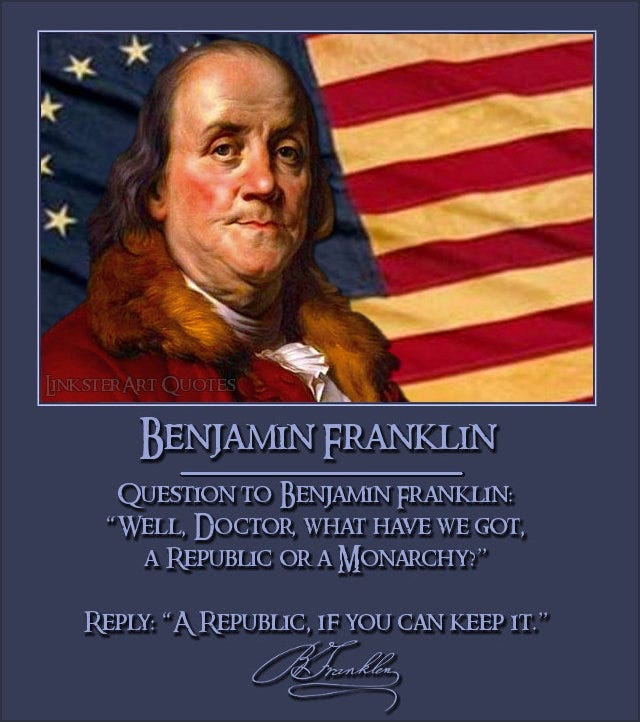
“We must, indeed, all hang together, or most assuredly we shall all hang separately.” - Benjamin Franklin, 1776
© Earl R Smith II, PhD